

You're Never Too Old To Stop Feeling So Old
Too Old for This Sh*t: How to Take Your Life Back from an Ageist Society


Yet another brilliant article for those of us who care deeply about how we age
OMG it’s been a week for reading and sharing terrific material.
Once again, I came across another piece that is so relevant for those of us who care and are mightily committed to vibrant health as we age. In this case, it’s our beloved (and my case, rather battered) brain.
Here you go:

Two quotes from this article that nailed my attention right away:
Passive scrolling — the thing most people do for three, four, five hours every single day — trains your brain into a state called low cognitive load. Your eyes track content. Your thumb moves. But your prefrontal cortex — the part responsible for deep thought, planning, and sustained attention — goes dormant.
When you scroll, you are not “relaxing.” You are putting your brain’s most important region into standby mode — for hours at a time, every single day. This is not recovery. This is atrophy with a user interface. (author bolded)
And this:
Your brain’s comfort zone is where synapses go to die.
Please kindly read that again.
Your brain’s comfort zone is where synapses go to die.
I’d suggest that doom scrolling in particular is guilty here; I have to wonder how much scrolling for research qualifies, but that’s just me.
This is why the recent article by The Atlantic called the lack of real reading- BOOK reading- a real crisis. It most assuredly IS a real crisis.
Discomfort is the handmaiden of growth. While our lazy-ass brain loves to create shortcuts, it loves challenges more. It rewards us for taking risks, working harder and choosing the higher path of difficulty vs. comfort.

This is why I recommend Michael Easter ’s The Comfort Crisis: Embrace Discomfort To Reclaim Your Wild, Happy, Healthy Self.
It’s why I love Brad Stulberg ’s new book The Way of Excellence: A Guide to True Greatness and Deep Satisfaction in a Chaotic World.
Everything that I have read, everything that I have put into practice in my own life in terms of better eating, more reading, more deep discomfort underscores the lessons in all of this.
All these things are connected. Those of us who read voraciously AND we exercise AND we mind our nutrition and social circles are likely not only to have very vibrant lives, but also, we don’t likely have medicine cabinets chock-full of medications and OTC drugs.
As for food, ever the question for those of us interested in both prevention and better brain care, this landed squarely for me. I wrote a book back in 2010 which discussed the toxic aspect of words. Social media has risen as one of the top sources of that kind of brain sewage to which we dedicate far too much time every day.
Cognitive decline terrifies all of us. It should. But it is no longer limited to the realm of those of us past a certain number.
The above article nails that reality. It’s an issue of brain rot at thirty, forty. It begins as soon as someone starts doom scrolling. Real cognitive decline decades before you’d expect it.
In us. Our kids. Their kids.
None of us has to suffer, but we have to do something about it ourselves. Far more importantly, parents have got to decide to actually parent, as opposed to handing their kids a device that sucks the brains right out of their bodies.
Using a smartphone as a babysitter is a thief of always. Our kids’ futures are being stolen and it’s our fault.
Maria Cross wrote the definitive book on how to feed your brain. For those of us who are well past sixty and who are terrified of anything that smacks of dementia, it’s an investment in not only prevention but also better management even if you are experiencing symptoms.
She writes regularly on Substack. I’m a fan. For those of us who are- as we should be- concerned about our brain health and are possibly watching some symptoms arise, the first first FIRST order of business is what goes into your mouth as everyday nutrition.
Second, the next order of business is what you’re putting into your body in the form of Over The Counter (OTC) drugs. We’ve been taught to believe they are safe.
I know I’m repeating myself here from other articles but we forget. When we don’t bother to check the acetaminophen content on LOTS of other drugs, we poison our livers. And worse. OTCs are not safe.
In fact, some of the side effects mimic what too many lazy doctors say are “just aging.” Know the most dangerous ones for those of us over fifty.
Truly good doctors want to know every drug in your medicine cabinet, every supplement, every single pill bottle you carry in your purse. They also want to know your diet, because while food doesn’t replace medication in some cases, food most definitely IS medicine in the highest sense.
Those OTCs often interact dangerously with whatever meds you’re taking for your conditions. When properly used, OTCs are safe, but when mixed with certain drugs, including alcohol, they can be damaging or even fatal. We may know this, but we also can forget. We’re human.
Again, such mixes can mimic age-related symptoms or other conditions, for which we all too often are prescribed yet MORE drugs which add insult to injury or end up potentially fatal.
AARP is a great resource for this kind of information. That said, I’m a fan of being healthy enough that you don’t need all those RX medications in the first place, just feeding yourself better, moving more and spending vastly less time on line.
That said, many of us, and my hand is up here, still need medication for a condition, which is why we have to be even more mindful of what we ingest.
A friend of mine has been using AI in one of the better applications of its strengths- organizing and presenting information. His website, zoimetrics.com,* addresses these very concerns. The site lays out common medications and the kinds of foods and/or supplements which can have harmful or even fatal interactions.
That kind of information is woefully under-reported. In fact, with so many fake influencers offering fake and pseudo-science and so many folks buying into that garbage, the chances are many of us are doing ourselves great and lasting harm. Websites like this, which clearly outline what to eat and take and what NOT to eat and take if you are on certain medications, will be increasingly essential.
Let’s just call this out: the raft of idiot influencers who have zero medical backgrounds is taking advantage of our distrust of the medical community and our desire for a quick fix.
Any time some damned fool tells you to strip down and expose your butt hole to the sun- something that Mother Nature NEVER intended or she’d have put our assholes on our heads (which kindly, she has, for that matter, for billions of us) PLEASE. Run in the opposite direction. Please.
In many cases there is no quick fix, just a gradual un-doing of previous damage, and better management going forward. Regaining our health after years of abuse takes years. I’ve had to do it myself after forty years of severe eating disorders; I’ve paid the price. The health I have now is the result of years and years of regular, small changes.

The incredible computing power now at our fingertips is as much a danger as it is a giddy opportunity. Like giving children the nuclear codes. The best example of that is sitting in the White House right now.
Bathe your brain properly
I had a conversation with a friend yesterday who reminded me that before I left for Ecuador last June, I had been complaining of a bit of brain fog. This was more than just not recalling why I was in the basement, or why on earth I was staring in my fridge.
I didn’t feel sharp.
It’s that logey, uncomfortable feeling that the world is on the other side of a shower curtain. This is commonly blamed on “just getting older.”
Bullshit.
First, a callback to an earlier point in this article. Here are common medications that cause brain fog, all too often pooh-poohed by our medical community and written off as a side effect of aging.
Again, bullshit. Look at your meds list FIRST AND FOREMOST.
Second: look at what you’re eating. Here’s a list of foods and liquids which can cause brain fog as well as real damage.
Again, read people who know what they’re talking about, like Maria Cross.
Don’t trust your health to the army of uneducated, untrained and predatory influencers who could give less of a shit about your brain and body.
Here’s what happened to my brain.
Those of you who are fans of Arthur Brooks, who also writes for The Atlantic, may have read his book, From Strength to Strength: Finding Success, Happiness, and Deep Purpose in the Second Half of Life.
He has some ideas about how our intelligence shifts as we age, and suggests that we stop considering it a decline but rather a remarkable refinement:
Brooks refers to two kinds of intelligence: “fluid” intelligence and “crystallized” intelligence. He defines fluid intelligence as “the ability to reason, think flexibly, solve novel problems, and is associated with reading and mathematical ability.” Fluid intelligence tends to peak early in adulthood and “diminishes rapidly starting in one’s thirties and forties.”
On the other hand, crystallized intelligence is “the ability to use a stock of knowledge learned in the past.”
Crystallized intelligence tends to increase with age through one’s forties, fifties, and sixties—and does not diminish until quite late in life, if at all.
Crystallized intelligence represents a person’s knowledge gained during life by acculturation and learning. When you are young, you have raw smarts; when you are old, you have wisdom. When you are young, you can generate lots of facts; when you are old, you know what they mean and how to use them. (author bolded)
Brooks’ work doesn’t address the fact that far too many of us cease to chase plenty of newness, new experiences and the like, which continues to push our fluid intelligence.
The act of reaching for novel solutions is a massive workout for the brain and keeps it young and flexible.
In midlife, when many have kids, the need for stability and predictability for them and to be able to plan for our own futures typically causes many if not most of us to stop chasing lots of new experiences. Both good and bad- the latter, because we stop demanding that our brains grow and evolve.
I believe that fluid intelligence is available our whole lives but we have to work at it. Being willing to take on deep discomfort takes balls.
Here’s what I did: I put myself into a 24/7 sheep dip of fundamentally different demands from visual to language to physical to food. Every day I am pummeled by something new. I struggle to find the right words in a world where English is not the primary language. I’m making new friends and writing and reading. I upgraded my diet, the quality of fruits, vegetables, meats and cooking oils, and walk absolutely everywhere that’s within a 45-minute hike.
Absolutely everything is different. Sometimes I am overwhelmed. Those days I pull out my Kindle and go back to reading Don Quixote (a break from my crime fiction, indeed). Mika and I bask in the sun, I drink dark, rich Loja coffee laced with dense cream, and I watch the shadows march across the small garden space in front of my apartment.
My brain is loving it.
Fuck McDonald’s. This is what it looks like to treat yourself. Especially after 70.
Yesterday I took a 40-minute mixto (truck transport) to a farm in the Tarqui valley where I spent an hour working on a newly-gelded horse. That was six months ago and he was still VERY full of himself. IFYKYK.
I put him through some paces, which he didn’t like, and resisted, which is why we’re doing it. It was hard work, and by the time we were done, Sheru and I were buds. I was challenged to keep my patience and my hands light but insistent, and he was challenged to listen to a new rider and respond to massage he’s never had.
Then, tired and dirty and hungry, I got on the wrong bus, missed the last possible stop near my place and had to figure out where I landed and manage my way home.
Brain food.
I am constantly faced with something new. Emotionally this can be irritating as hell because I am out of my element. Master of nothing. I am constantly reminded that I don’t know shit (never did anyway, but this is on steroids). My brain is bombarded, constantly challenged and working overtime.
I haven’t had the slightest tetch of brain fog since April of this year. If anything, since arriving, I have felt sharper, more youthful, more alive than I have in years.
This is exactly how my brain feels right now:
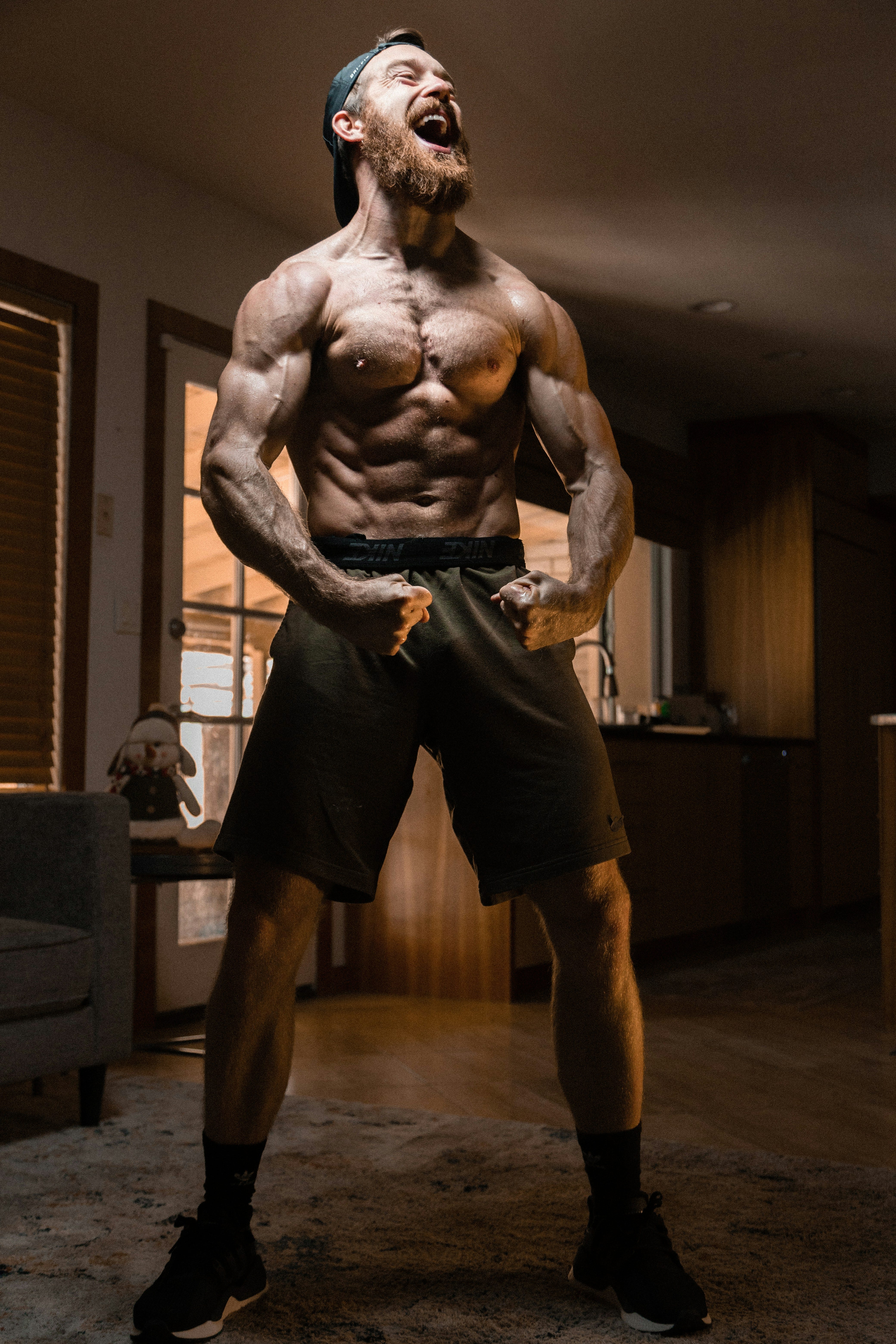
I’d bloody well give anything to have a similar photo of a seventy-ish woman doing the exact same pose on Unsplash.
There is indeed joy in getting old and older, especially when we feed our brains the right food, challenge our brains with the right problems, love our brains with the right respect and stop berating our brains for not being young.
What we have as we age is infinitely better than raw smarts, which often leads to very stupid outcomes.
I no longer have brain fog.
When I write articles like this, this is not about bragging. It’s about watching what’s changed- being aware and awake to those changes. When there are good articles which make sense of what I’m seeing, especially those which tell us how to be better, how to feed ourselves better, how to live more vibrantly within the boundaries of what we have, I’m going to pass them along.
The above resources are all books, with the exception of Maria Cross’ Substack. There are great writers on this forum, and they also in many cases, as in mine, have produced books.
Books change lives. READ.
There are plenty of people out there getting it done a lot better than I am.
There are plenty of people out there who don’t give a shit, too.
Those aren’t my people.
My people are going to want to be reminded of what we already know and too often forget to do, like stop scrolling. My people want reminders that there is always improvement available, and that the inconvenience and/or discomfort paid are worth the price of feeling seriously, wickedly alive.
They aren’t stopping. They’re still growing. No matter what the challenges, the roadblocks, the physical issues we carry.
At any age.
Let’s play.

It takes considerable time and effort to produce, research and deliver articles like this, and they are in every way a work of love and respect. If you get value from my writing, please consider supporting my work:
Thank you.
*zoimetrics.com: I’ve known the author since 2008 and trust their integrity. No financial relationship to him or the site. I am a huge fan of what they’re doing as it is both long overdue and very necessary.
Terrific article....how do we all get this to the people who most need it? Unfortunately, the people reading this post, and the people who saw/read The Atlantic piece, this is like preaching to the choir....
I enjoyed the links in this essay...when I started taking statins about 8 to 10 years ago, It was on a small dosage. I noticed immediately that I had word retrieval problems and that after three days or actually after a week of taking statins I had brain fog. I told my doctor this; I also told him I was taking it three days a week one day off and then three days on that's what I've been doing. It seems to be helping the brain fog.
On a different note with over-the-counter medications, I've been dealing with a frozen shoulder, actually two frozen shoulders, since January of last year. the left frozen shoulder, my non-dominant side, was resolved in about four months of PT. the dominant side, however, is not as I have bone-on-bone loss of cartilage. My orthopedic DO said to restrict use of NSAID for the pain - no more than a week - because in ppl over 65, research has shown in makes the gut more porous. He recommended only occasional use of Aleve, which works well for the inflammation in both shoulders (yeah the left one has arthritis too), and stick to Tylenol, in moderation.
Brava on having no brain fog. WOW. The pain & stress following all those surgeries is probably lifted and the stress of not knowing if your house would sell the second time around is also lifted. The kind of stress that you are experiencing now is it is a good kind the kind that forces you to learn something new to satisfy your curiosity about your new geography and new language.